

News
At the panel Heinrich Böll Stiftung Istanbul Office organized on 24 November at the Orient-Institut Istanbul, the speakers were Syrian women. While they acknowledged concerns about women’s rights in a country undergoing transition, they also delivered a clear message: “We are not just victims, but political agents.”

It has been more than a year since the Baath regime in Syria was overthrown. Yet the country remains in a painful transition. After years of war and repression, hopes are alive—so are anxieties.
One of the biggest questions surrounding the country is whether women’s rights—already in poor condition before the war—will become even more restricted. The Islamic-referenced legal order shaping the transition period fuels these concerns, despite the presence of a vibrant civil society in which women see themselves not as victims but as actors.
So what are Syrian women saying, and what are they thinking?
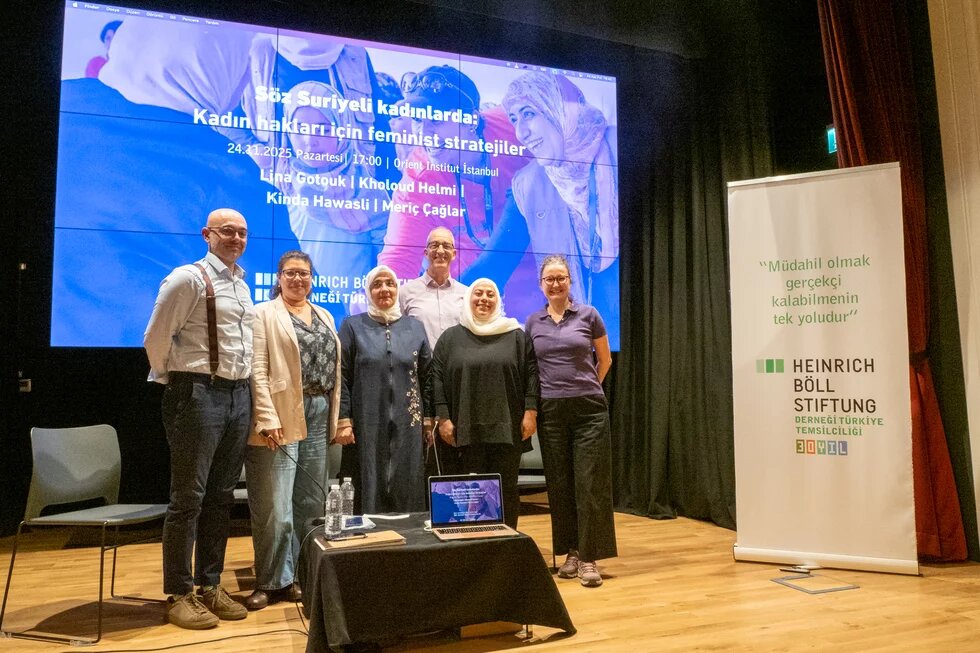
On 24 November, three women experts from Syria and one from Turkey took the stage, sharing perspectives and experiences from their fields of activism and professional work.
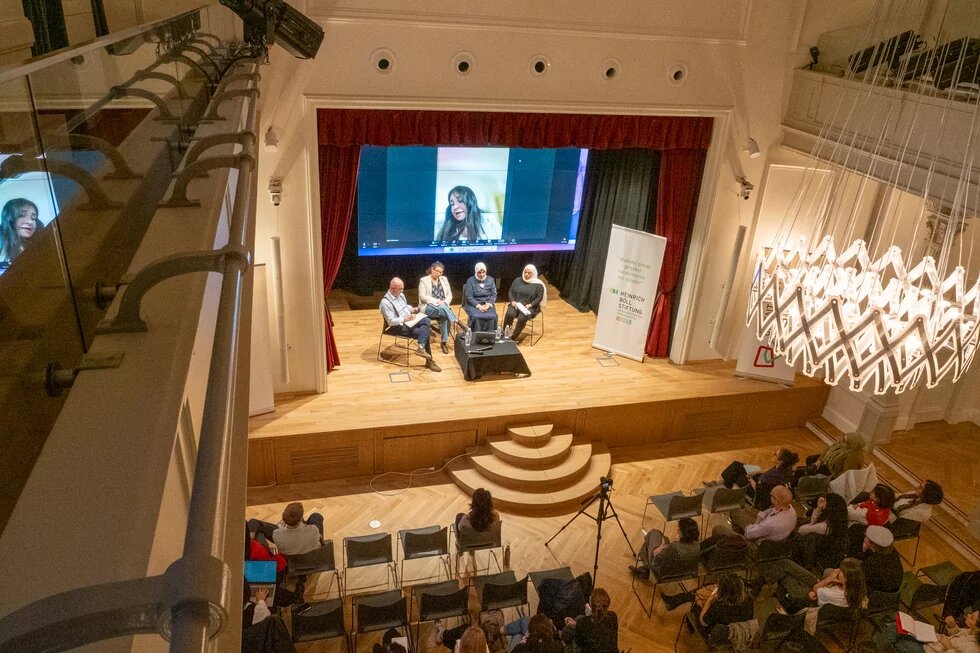
Seventy participants from civil society, academia and the media—both Turkish and international—attended the panel titled “Women’s Voices from Syria: Feminist Strategies for Rights,” organized by the Heinrich Böll Stiftung Istanbul Office in cooperation with the Orient-Institut Istanbul.
“A space for a common feminist objection”
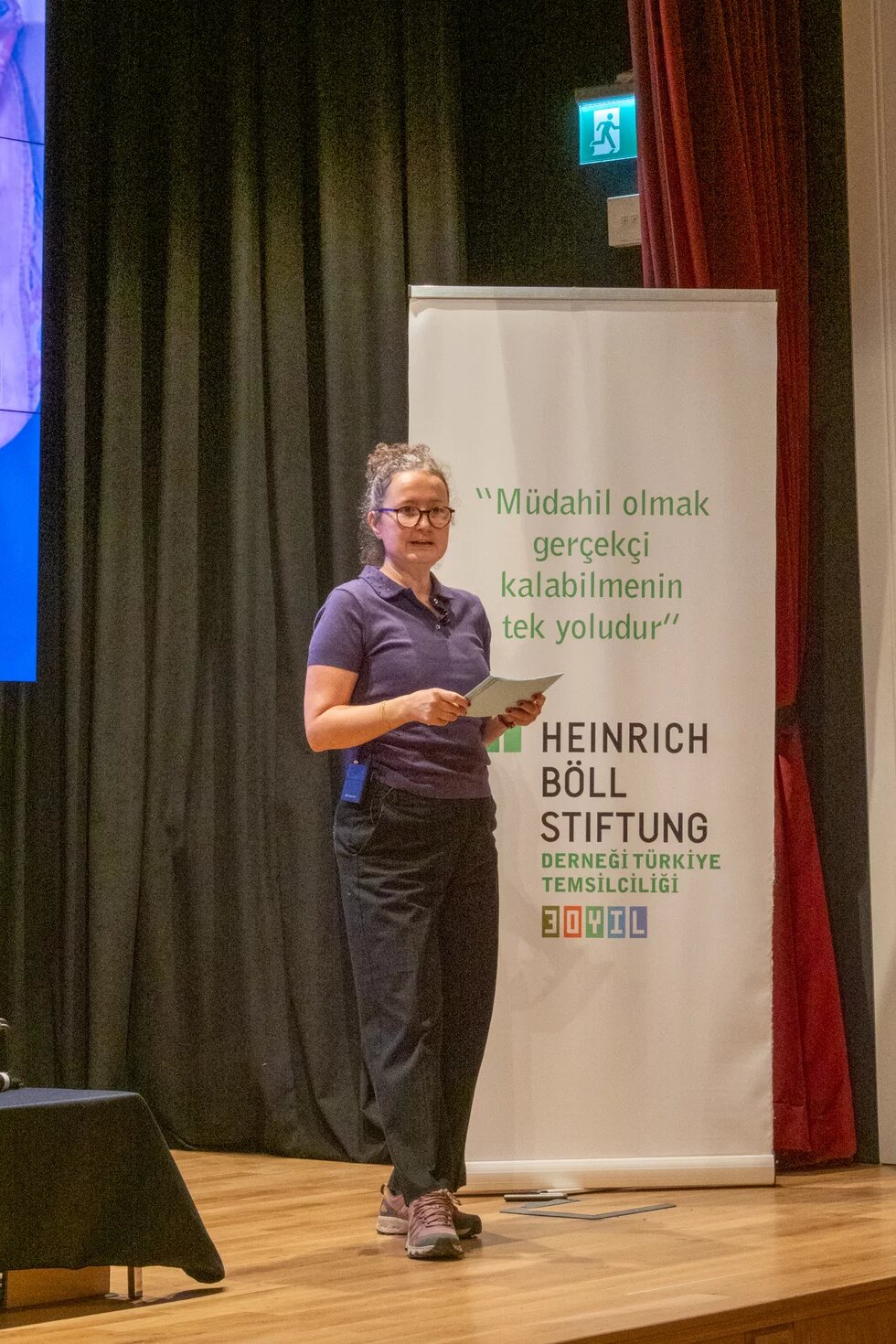
In her opening remarks, Yonca Verdioğlu, one of the coordinators of the Heinrich Böll Stiftung Istanbul Office, pointed out that patriarchal state logic operates similarly in both countries:
“The bargaining of women’s rights, the transformation of their bodies into instruments of political legitimacy, the monopolization of representation mechanisms by men, and the use of law and religious references as tools of oppression—these are things we all know and experience. We must see what is happening in Syria not as an exceptional crisis but as a common practice of regional patriarchy. That is why the struggle waged by Syrian women is directly connected to the struggle of the feminist movement in Turkey. And this panel is precisely for that reason not only a space for solidarity, but a space for a shared feminist objection to the patriarchal political order.
At a panel titled “Women’s Voices from Syria: Feminist Strategies for Rights,” Syrian researcher and human-rights specialist Lina Ghoutouk presented her inputs on “Syrian Women between Law and Practice.” Lina sketched a nuanced post-Assad landscape arguing that despite early fears of religious restrictions, daily life for many Syrian women remains relatively open, even as signs of institutional Islamization emerge in parts of the security apparatus.
She detailed how entrenched legal barriers, especially Syria’s Personal Status Law governing guardianship, inheritance, polygamy, mobility, and custody, continue to constrain women, who have nonetheless shouldered wartime burdens as breadwinners and organizers and now face persistent security gaps, including abductions and low trust in authorities, with minority communities particularly vulnerable. Politically, women remain marginalized: only 14% of recent parliamentary candidates were women and just six-won seats. Thus, prompting the panelist’s call for Syrian-led change: empower local women’s organizations, pursue context-sensitive legal reform, strengthen accountable policing and justice, expand women’s participation in governance, and center Syrian women’s own narratives over top-down external templates.
Competing narratives
In the same panel, journalist and Enab Baladi co-founder Kholoud Helmi argued that Syria’s transition is as much a struggle over narrative as it is over institutions, with media serving as the battleground where women’s rights are defended or diluted. Her presentation centered on “The Role of Media in Advocacy for Syrian Women’s Rights” and Helmi’s recalled how early alternative media created “in-between” spaces that let women speak openly, document abuses, and challenge patriarchal norms, before militarization shrank that space through harassment, gatekeeping, and the reassertion of male control.
Helmi called for a feminist media agenda that centers marginalized women’s voices, protects women journalists, tracks gendered outcomes of the transition, builds cross-community solidarity, and resists efforts to recast women as mere symbols; the strength of women’s voices in media, she concluded, will shape their power in law, politics, and society.
A third panelist contributed to the panel with her input concerning “Civil society as a safe space for Syrian women’s solidarity” Kinda Hawasli aid years of conflict have pushed women into acute precarity, marked by mass displacement (3.5 million to northwest Syria), loss of documents, detention and disappearances, rising domestic violence, early marriage, and a sharp fall-off in schooling (dropout rates 8% for ages 7–12 and 17 percent for 13–15), even as overall labor-force participation climbed amid necessity. Charts presented showed nearly half of IDP camps in opposition areas by late 2024, with about 8 percent female-headed households and only a quarter of camp residents able to return by 2025 as aid declined.
Civil society’s record was mixed: it expanded women-focused projects, jobs, studies, and political training, yet too many initiatives were donor-driven, short-term, and elitist, missing real needs and sometimes stoking social tension. The panel urged a pivot to rigorous needs assessments, long-horizon programs (education, vocational training, GBV protection, and economic empowerment), meaningful representation in decision-making, and the building of genuine solidarity networks and safe spaces across regions and communities.
Finally, in the session covering “The Role of Turkish Feminist Advocacy in Amplifying Syrian Women’s Political Agency,” Meriç Çağlar warned that a worldwide anti-gender backlash is reshaping aid, language, and activism. Hence, pushing gender work to the margins, shrinking budgets, and enabling conservative actors to capture funding while UN/INGO spaces shy away from even using the word “gender.”
In Turkey, this trend converges with a pro-family policy turn, withdrawal from the Istanbul Convention, and mounting pressure on feminist groups, leaving refugee rights work “projectized” and many Syrian women treated as beneficiaries rather than political actors. By contrast, Kurdish and queer movements were better at integrating women refugee leaders. Çağlar called for a cross-border, non-hierarchical feminist front that draws on Turkey’s proven strengths in legal advocacy, applies a gender lens to return policies and protection gaps, and builds durable alliances beyond donor cycles with a bolder public language that resonates with youth and resists efforts to depoliticize equality.
The event concluded with a dynamic Q&A session that lasted about an hour, followed by a cocktail reception.